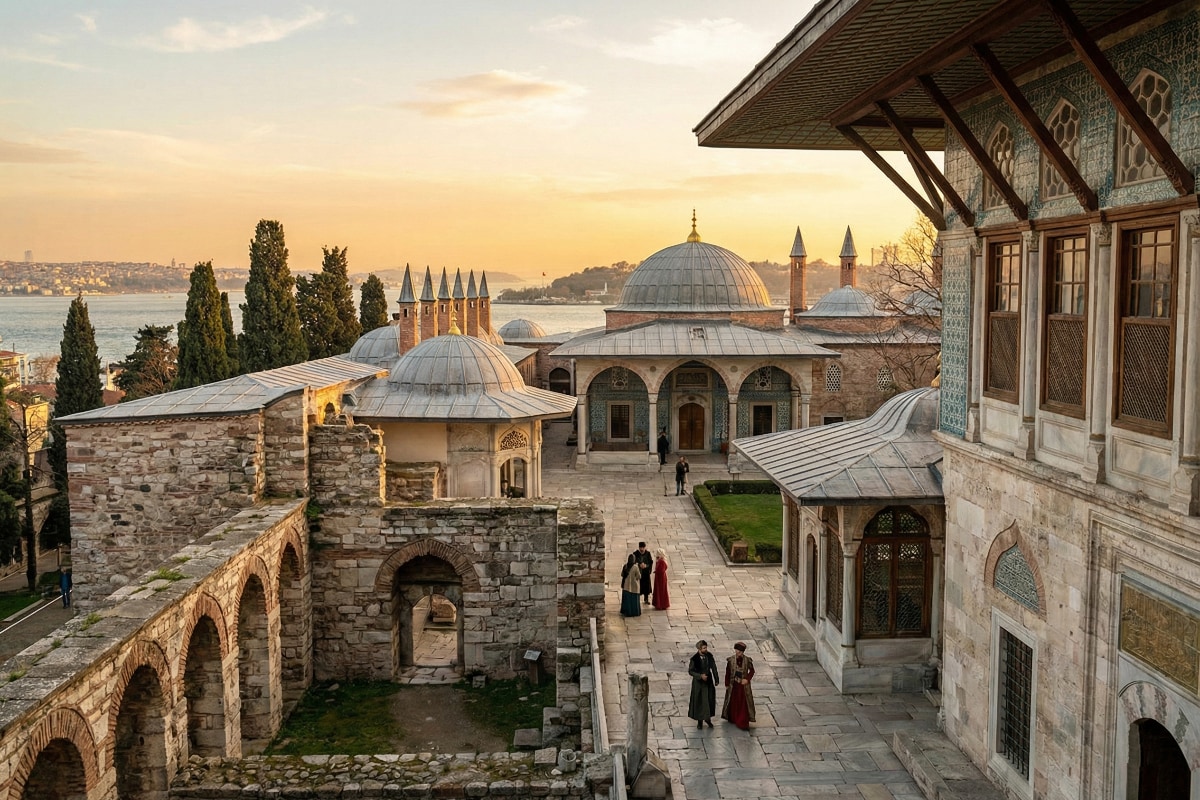
Standing at the tip of the Historic Peninsula, where the waters of the Golden Horn mix with the Bosphorus and the Sea of Marmara, one cannot help but feel the weight of history. This specific promontory, known as Sarayburnu, is not merely a scenic viewpoint; it is the palimpsest of empires. While the silhouette of Topkapi Palace is distinctively Ottoman, the ground it rests upon holds the whispers of a much older legacy. As we explore the corridors and courtyards of this imperial residence in 2026, we are walking through a timeline that stretches back to the ancient acropolis of Byzantium, witnessing a unique architectural dialogue between East and West that has evolved over centuries.
The Ghost of Byzantium: What Lay Beneath
Before Mehmed the Conqueror laid the first stone of his 'New Palace' (Saray-i Cedid) shortly after the conquest of Constantinople, this hill was the beating heart of the ancient Greek city of Byzantion. The Ottomans, pragmatic and respectful of geography, chose the exact site of the Byzantine Acropolis for their seat of power. Unlike the total erasure seen in other conquests, the architectural evolution of Topkapi Palace began with an adaptation of existing Byzantine substructures.
The most striking survivor of this era, nestled within the First Courtyard, is the Hagia Eirene. It stands as a testament to the Ottoman policy of architectural tolerance and utility. While the Hagia Sophia was converted into a mosque, Hagia Eirene remained a church, used primarily as an arsenal. Its raw brickwork and basilica form offer a stark, fascinating contrast to the refined Ottoman pavilions that would later rise around it. Furthermore, deep beneath the Second and Third Courtyards lie Byzantine cisterns and substructures, which the Ottoman architects ingeniously utilized as foundations for their kitchens and treasuries, literally building their empire upon the physical support of their predecessors.
Mehmed the Conqueror’s Vision: The Tent in Stone
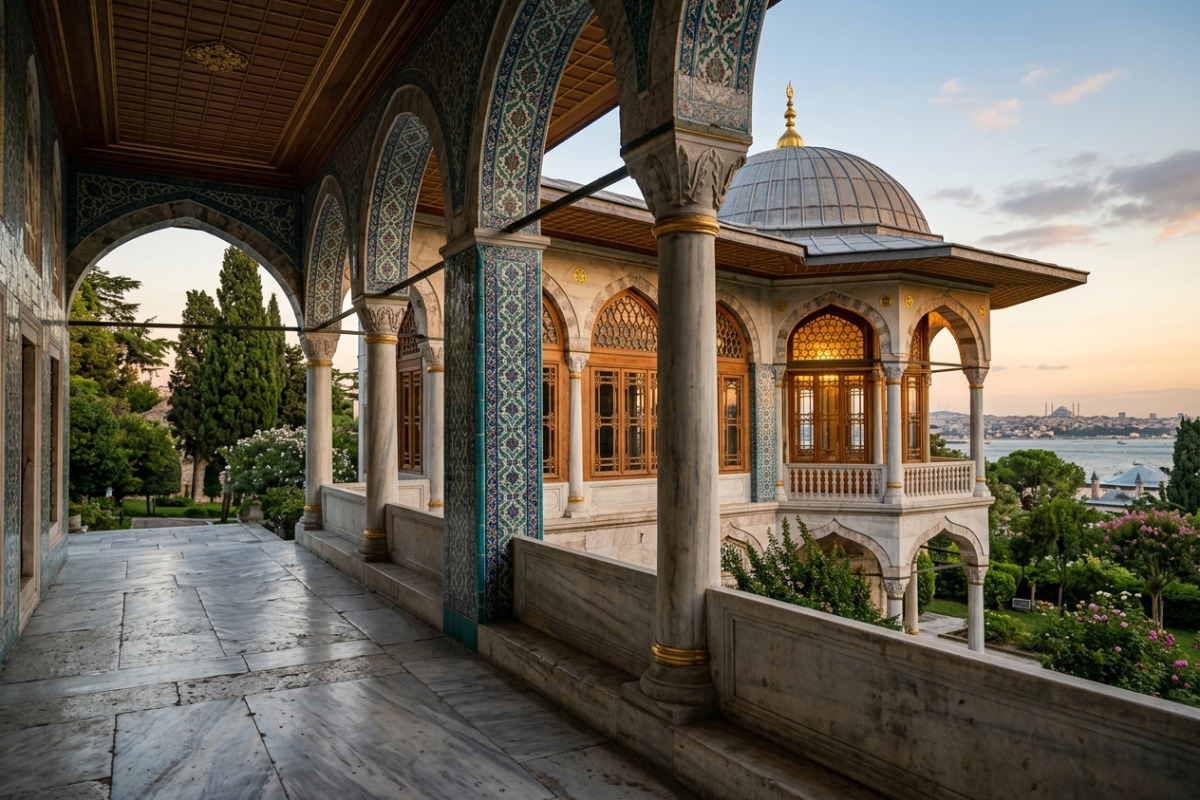
When Sultan Mehmed II began the construction of Topkapi in the 1460s, he did not seek to replicate the monolithic, vertical palaces of Europe. Instead, he drew inspiration from his nomadic Turkic roots. The initial layout of Topkapi Palace is often described as 'tent architecture' solidified in stone. The palace is not a single building but a collection of pavilions, kiosks, and service buildings arranged around expansive courtyards, much like an imperial encampment frozen in time.
This distinct layout reflects a cultural philosophy that values connection with nature and hierarchical seclusion. The design encourages a flow between indoor and outdoor spaces, a feature that was quite revolutionary compared to the fortress-like palaces of the West. The progression from the First Courtyard (accessible to the public) to the Fourth Courtyard (the Sultan's private sanctuary) demonstrates a calculated architectural narrative of power and privacy.
- The First Courtyard: A service area and parade ground, integrating the Byzantine Hagia Eirene.
- The Second Courtyard: The administrative heart, housing the Divan (Imperial Council) and the kitchens.
- The Third Courtyard: The educational and private center, home to the Enderun School.
- The Fourth Courtyard: A collection of pleasure pavilions and tulip gardens offering solace to the Sultan.
Architectural Adaptations Through the Centuries
Topkapi Palace is not a static monument; it is a living organism that grew and changed for nearly 400 years. As the empire expanded and cultural winds shifted, so did the architecture of the palace. Each Sultan added a wing, a kiosk, or a decoration that reflected the artistic zeitgeist of his era. This continuous evolution prevents the palace from belonging to a single architectural style, making it a museum of Ottoman architectural history in itself.
The Golden Age: Classical Ottoman Majesty
Under the reign of Suleiman the Magnificent, the palace underwent significant expansion, largely overseen by the legendary chief architect, Mimar Sinan. This era solidified the 'Classical Ottoman' style, characterized by balanced geometry, lead-domed roofs, and a focus on functionality. The massive palace kitchens, with their iconic chimneys that define the skyline, were rebuilt by Sinan. These structures are masterpieces of engineering, designed to feed thousands while minimizing fire risks, showcasing how practical needs drove architectural innovation.
The Rococo and Baroque Infusion
As we move into the 18th and 19th centuries, the architectural language of Topkapi begins to stutter with a European accent. During the 'Tulip Era' and subsequent years, the Empire opened up to Western influences, and this is vividly reflected in the later additions to the palace. The rigid geometry of the classical period gave way to the curvy, floral, and ornate styles of Baroque and Rococo.
A prime example of this shift is the decoration within the Harem and the specific kiosks built by later Sultans. The Fruit Room of Ahmed III is a dazzling display of painted wooden panels featuring floral arrangements, a sharp departure from the abstract geometric patterns of the earlier Iznik tiles. This era marks a fascinating period where the East absorbed the West, creating a hybrid style that is uniquely Istanbulite—opulent, colorful, and slightly whimsical.
The Harem: A Microcosm of Cultural Shifts
Perhaps nowhere is the evolution of style more palpable than in the Harem. This labyrinth of corridors and chambers is not just a residence; it is a timeline of decorative arts. The early sections, such as the Courtyard of the Black Eunuchs, reflect a somber, functional aesthetic. However, as you move deeper into the Queen Mother’s apartments and the Imperial Hall, the walls explode with the finest Iznik tiles from the 16th century, showcasing the zenith of Ottoman ceramic art with their tomato-reds and turquoise blues.
Yet, just a few rooms away, you encounter 19th-century European chandeliers, gold-leafed mirrors, and landscape frescoes that wouldn't look out of place in a French chateau. This juxtaposition is the soul of Topkapi. It tells the story of an empire that started on the steppes, conquered Byzantium, ruled the Mediterranean, and eventually looked toward Europe, all recorded in the layers of plaster, stone, and tile.
Comparative Overview: Architectural Styles
To better understand the diverse influences that make up the palace complex, we can look at the distinct characteristics that differentiate the eras visible within the walls.
| Feature | Byzantine Influence | Classical Ottoman (15th-17th C.) | Late Ottoman (18th-19th C.) |
| Structure Type | Basilicas, Cisterns, Brickwork | Pavilions, Courtyards, Stone & Lead | Integrated Palaces, Multi-story |
| Decoration | Mosaics, Frescoes (Religious) | Iznik Tiles, Geometric Calligraphy | Baroque Frescoes, Gold Leaf, Mirrors |
| Focus | Defensive & Religious | Privacy, Nature, Horizontal Flow | Ostentation, Western Comfort |
| Key Example | Hagia Eirene | Privy Chamber (Has Oda) | Sofa Mosque, Mecidiye Kiosk |
Preserving the Narrative
Today, as we wander through these sun-drenched courtyards, we are not just looking at a museum; we are reading a biography of a civilization written in architecture. The transition from the Byzantine ruins to the tent-like pavilions of Mehmed II, and finally to the Rococo interiors of the late empire, offers a physical manifestation of Istanbul's layered identity. Topkapi Palace remains a majestic reminder that architecture is never static—it evolves, adapts, and survives, much like the city that surrounds it.