Walking through the Imperial Gate of Topkapi Palace is more than just a visit to a museum; it is a deliberate step into a narrative that has been unfolding for nearly six centuries. As we stand here in January 2026, the walls of this sprawling complex seem to whisper stories of power, devotion, and artistry that have transcended empires. The collection housed within these courtyards is not merely an assortment of objects; it is a living biography of the Ottoman Empire, evolving from the personal possessions of conquerors to a global heritage site that bridges the East and the West. To understand the soul of Istanbul, one must trace the lineage of these treasures, understanding how they were amassed, preserved, and how they continue to captivate the modern imagination.
The Inception: Building the Imperial Treasury
The story of the Topkapi collection begins in the late 15th century with Sultan Mehmed the Conqueror. Following the conquest of Constantinople, Mehmed II sought to establish a residence that reflected the grandeur of his new status as the ruler of two lands and two seas. However, the initial accumulation of items was not intended for public display but for the Enderun, the inner sanctuary of the palace. In these early years, the collection was a symbol of legitimacy and absolute power, comprising spoils of war, diplomatic gifts, and the finest craftsmanship the empire could produce.
Unlike modern museums that curate based on themes, the early Ottoman treasury was a functional vault of dynasty assets. It held gold bullion and minted coins alongside artistic masterpieces, blurring the lines between financial reserve and art collection. The items from this era, particularly the early weaponry and illustrated manuscripts, reflect a raw, martial energy combined with a refined Persian aesthetic influence, setting the foundation for what would become a distinct Ottoman style.
The Golden Age: Expansion and Diplomatic Splendor
As the empire expanded its borders during the 16th century, particularly under the reign of Suleiman the Magnificent, the nature of the collection underwent a dramatic transformation. The influx of wealth from new provinces and the strategic importance of the Silk Road turned Topkapi into a repository of global culture. This era introduced a staggering variety of items that went beyond mere military prowess, showcasing the empire’s central role in global trade and diplomacy.
- Chinese Porcelain: The palace houses one of the finest collections of Chinese blue-and-white porcelain in the world, valued by Sultans not just for beauty but for the belief that celadon would change color if touched by poisoned food. The collection boasts over 10,000 pieces, a testament to the Ottoman Empire's insatiable appetite for these exquisite wares.
- Jeweled Objects: This period saw the creation of items like the famous Topkapi Dagger, where functionality was completely overtaken by ornamental excess, featuring emeralds and diamonds that signaled ultimate luxury. The dagger, crafted in 1747, was intended as a gift for Nadir Shah of Persia, but he was assassinated before it could be delivered.
- Textiles and Kaftans: The preservation of imperial wardrobes began in earnest, with silk brocades woven with gold thread serving as a testament to the economic might of the Ottoman textile industry. Some kaftans required over a year to complete, employing the most skilled artisans in the empire.
The Acquisition of the Holy Relics
Perhaps the most pivotal moment in the evolution of the collection occurred in 1517, following Sultan Selim I’s conquest of Egypt. With the transfer of the Caliphate to the Ottoman dynasty, the Sacred Trust—the personal belongings of the Prophet Muhammad and other significant religious artifacts—was brought to Istanbul. This event fundamentally shifted the spiritual gravity of the palace. The collection was no longer just about worldly power; it became the spiritual heart of the Islamic world.
For centuries, these relics were kept in the Chamber of the Holy Mantle, attended to by recitations of the Quran that have continued uninterrupted for hundreds of years. The integration of these sacred items added a layer of reverence to the Topkapi collection that protected it even during the empire's periods of decline. It transformed the treasury from a storehouse of wealth into a sanctuary of faith, a distinction that remains palpable to visitors today.
Preservation Amidst Turbulence and Change
The path from an imperial residence to a modern museum was fraught with challenges. Throughout the 18th and 19th centuries, the palace faced earthquakes, fires, and the slow political decline of the empire. While the Sultans eventually moved to the European-style Dolmabahçe Palace, the Topkapi treasury remained the symbolic core of the dynasty. It was during these twilight years that the concept of "inventory" began to modernize, with more systematic efforts to catalog the vast accumulation of objects.
The most significant evolutionary leap occurred with the establishment of the Turkish Republic. In 1924, Mustafa Kemal Atatürk decreed that Topkapi Palace be converted into a museum. This decision was revolutionary; it democratized access to treasures that had been hidden from the public eye for centuries. The transition required a massive shift in perspective: the items were no longer the private property of a sovereign but the shared cultural heritage of a nation and the world.
The Collection in Contemporary Society
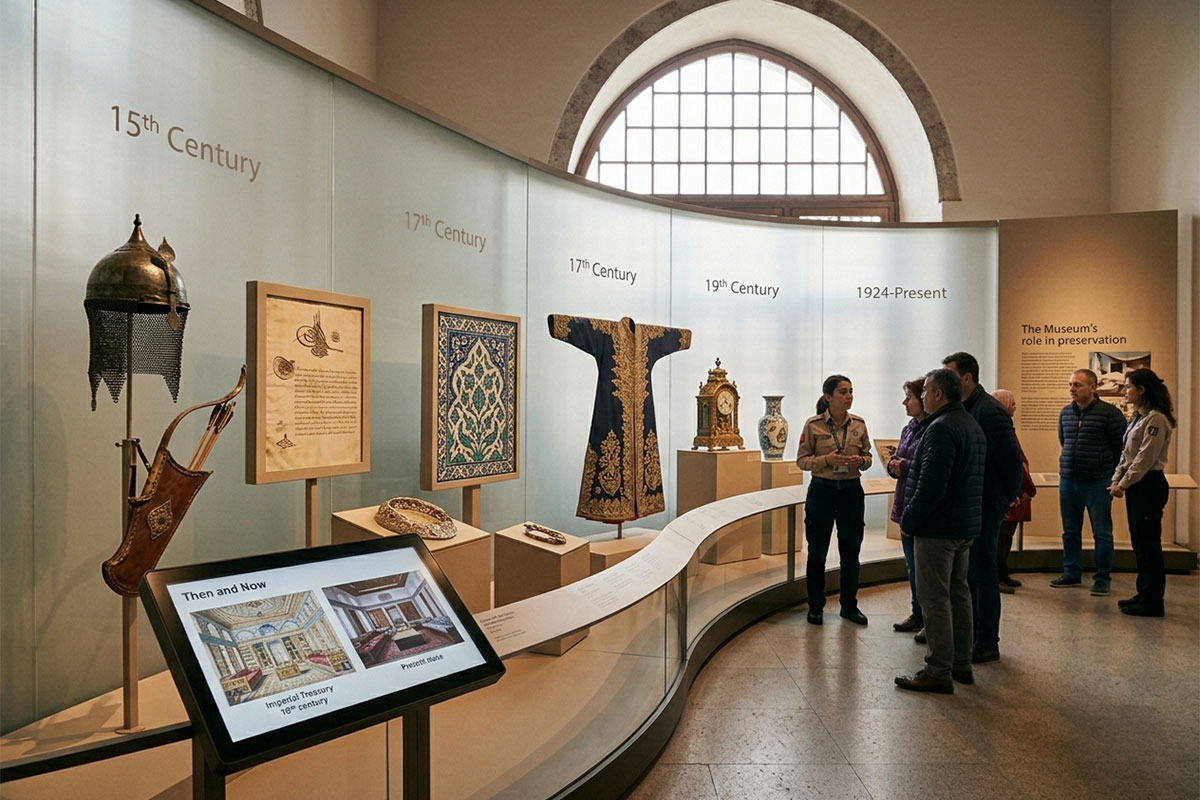
In the modern era, the Topkapi collection serves a different purpose. It is no longer about projecting the might of a Sultan, but rather about education, conservation, and cross-cultural dialogue. Advanced restoration techniques and climate-controlled display cases have replaced the heavy iron chests of the past. Curators today face the challenge of contextualizing these items for a global audience, explaining the intricate history behind a diamond or a manuscript without losing the mystique that surrounds them. As of 2023, the museum attracts over 3 million visitors annually, showcasing its enduring appeal and global significance.
| Category | Key Highlights | Historical Significance |
| The Imperial Treasury | Spoonmaker's Diamond, Topkapi Dagger | Represents the absolute wealth and artistic patronage of the Ottoman court. |
| Holy Relics | Holy Mantle, Sword of the Prophet | Legitimized the Ottoman Sultans as Caliphs of the Islamic world. |
| Porcelain Collection | Yuan and Ming Dynasty Celadon | Demonstrates the empire's critical position on the Silk Road trade routes. |
| Imperial Wardrobe | Ceremonial Kaftans, Talismanic Shirts | Offers insight into court hierarchy, textile technology, and royal fashion. |
Today, the collection is a bridge connecting the past to the present. It reminds us that globalization is not a new phenomenon; the mixture of Chinese porcelain, Indian rubies, Venetian glass, and Austrian clocks within the palace walls proves that Istanbul has always been a cosmopolitan hub. The evolution of the Topkapi collection is a testament to the resilience of history. It has survived wars, natural disasters, and regime changes to stand as a beacon of human creativity and endurance.
A Timeless Legacy
As we explore the Topkapi Palace today, we are witnessing the result of centuries of gathering, protecting, and curating. The evolution of this collection mirrors the trajectory of the Ottoman Empire itself—rising from a warrior state, reaching a zenith of cultural splendor, navigating a complex decline, and finally emerging as a cherished guardian of history. For the modern traveler, the collection offers more than just visual beauty; it offers a profound connection to the human story, preserved in gold, ink, and stone.