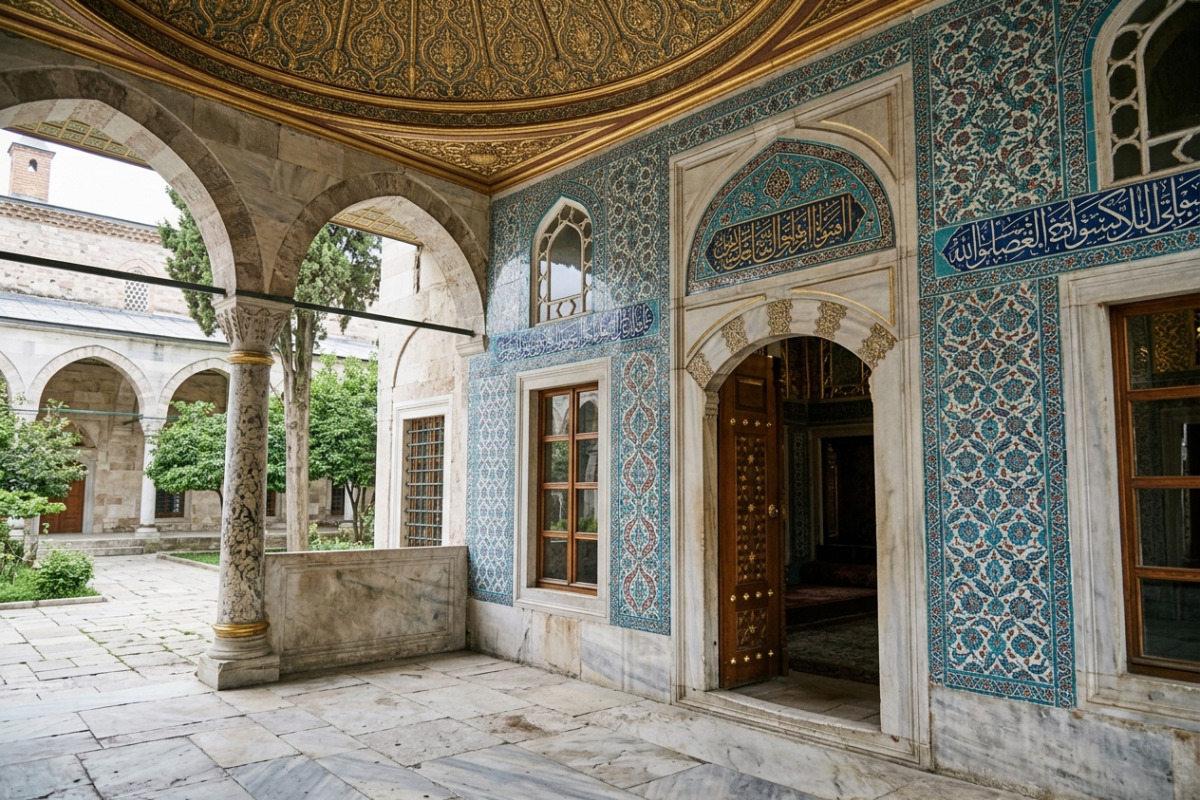
Walking through the imposing Imperial Gate of Topkapi Palace is not merely a physical entry into a museum; it is a transcendent journey into the soul of a civilization that ruled three continents. For centuries, this sprawling complex served as the administrative and residential heart of the Ottoman Empire, but its walls hold much more than political history. The collections housed here are a testament to a profound synthesis of faith, power, and artistic expression. As you navigate the courtyards in this crisp January of 2026, you begin to realize that every gemstone, every stroke of ink, and every ceramic tile is imbued with the deep spiritual and aesthetic principles of Islamic art. The Ottomans did not view art as separate from life or faith; rather, they saw it as a reflection of the divine order, a concept that transforms a visit here into a deeply emotional experience.
The influence of Islamic art on the Topkapi collections is pervasive, shaping everything from the humblest kitchen vessels to the most opulent thrones of the Sultans. Unlike Western art traditions that often prioritized realistic figuration, the Islamic aesthetic found in Topkapi focuses on the abstract, the geometric, and the calligraphic. This approach was not a limitation but a liberation, allowing Ottoman artisans to explore the infinite through patterns and the divine word. The collections reveal a constant dialogue between the earthly grandeur of the Sultanate and the spiritual humility required by Islam, creating a unique 'Ottoman' style that refined and elevated earlier Islamic artistic traditions to new heights of sophistication.
The Essence of Ottoman Aesthetic: Where Faith Meets Art
To truly appreciate the collections at Topkapi, one must understand the core philosophies of Islamic art that underpin them. The concept of Tawhid, or the unity of God, is visually translated into the endless geometric patterns and arabesques found throughout the palace's artifacts. These designs have no beginning and no end, symbolizing the infinite nature of the Creator. In the Ottoman context, this was blended with a love for nature, resulting in a style where rigid geometry softened into flowing floral motifs. The artisans of the court, known as the Ehl-i Hiref (Community of the Talented), were drawn from all corners of the empire, yet they worked within a unified artistic language that prioritized harmony, balance, and spiritual symbolism over individual ego.
This aesthetic is not just decorative; it is functional and symbolic. When you look at the kaftans worn by the Sultans or the ornate boxes used to store precious items, you see a deliberate avoidance of empty space, known as horror vacui. Every inch is utilized to glorify beauty, which in Islamic tradition is seen as a reflection of God's attributes. The influence is evident in the choice of colors as well; the turquoise of the tiles, the deep blue of the lapis lazuli, and the gold of the illumination all carry cosmological and spiritual meanings that would have been immediately understood by the Ottoman elite.
The Sacred Trusts: Relics of Spiritual Magnitude
Perhaps the most profound example of Islamic influence is found in the Chamber of Holy Relics (Has Oda). Here, art subserves the holy. The collection includes items belonging to Prophet Muhammad (PBUH), earlier prophets, and the Companions. However, it is the artistry surrounding these relics that showcases the Ottoman devotion. The reliquaries—boxes and chests made to hold these items—are masterpieces of gold, silver, emeralds, and diamonds. Yet, despite the immense material value, the design focuses on reverence. The inscriptions on these chests are not boasting of wealth but are Quranic verses and prayers, executed in the finest calligraphy.
The presentation of these items highlights a key theme in Islamic art: the veneration of the written word and the sacred lineage. The lighting is dim, the atmosphere is hushed, and the continuous recitation of the Quran by living Hafiz (which has continued for centuries) adds an auditory layer to the artistic experience. The artifacts here, such as the Holy Mantle, are wrapped in layers of embroidered silk, showcasing the pinnacle of Ottoman textile art. These textiles are woven with silver and gold threads in complex patterns, demonstrating how the industrial arts were elevated to act as servants to the spiritual realm.
Calligraphy: The Visual Symphony of the Word
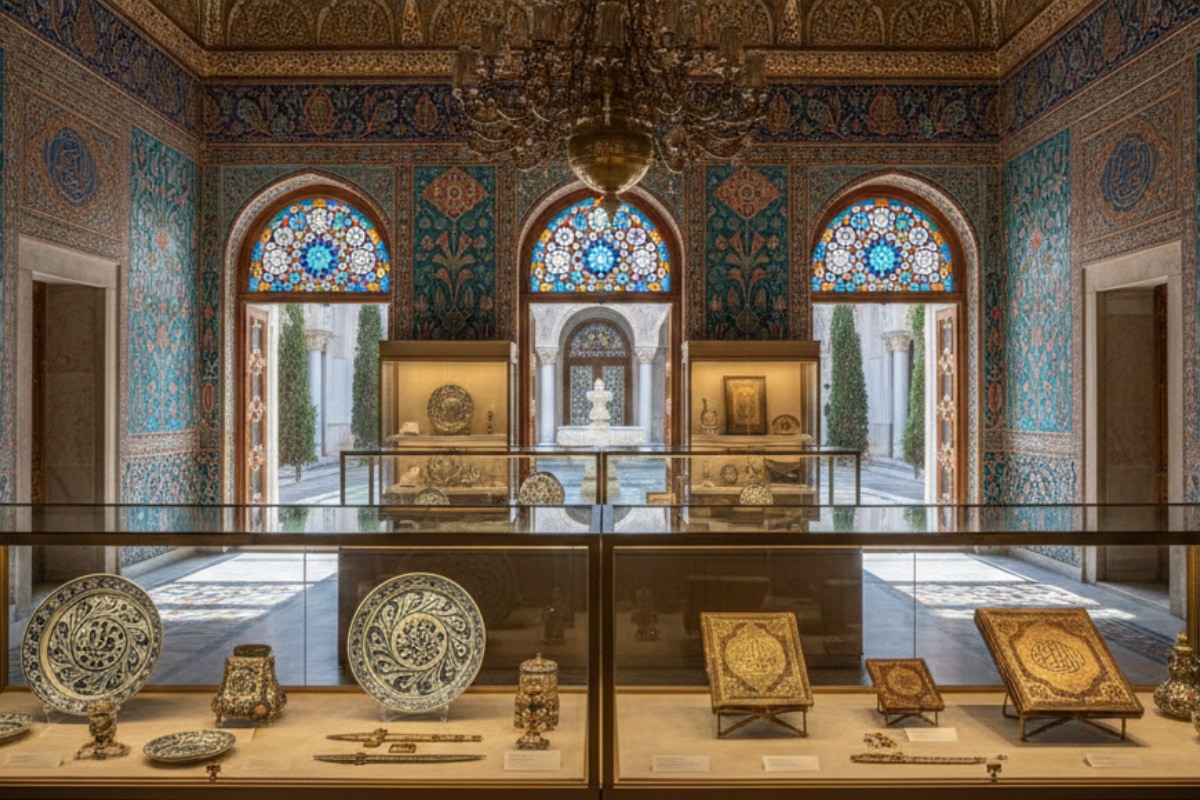
In the hierarchy of Islamic arts, calligraphy sits at the very top, and the Topkapi Palace Library houses some of the world's most significant examples. The Ottomans famously adopted the saying, "The Quran was revealed in Mecca, recited in Cairo, and written in Istanbul." This is not an exaggeration. The collection of manuscripts demonstrates the evolution of scripts like Thuluth, Naskh, and Talik. Calligraphy was used not just for books, but as a primary decorative element on swords, helmets, and even everyday objects.
The calligraphers, or Hattats, were considered the highest rank of artists. Their work in the Topkapi collections shows how letters were transformed into visual art. The Tughra (imperial monogram) of the Sultans is a perfect example of this. It functioned as a royal seal, but its design is a masterpiece of calligraphic composition, blending the Sultan's name with the title "Ever Victorious" in a harmonious, boat-shaped structure. These documents are illuminated with real gold (tezhip), creating a glowing effect that symbolizes the divine light of knowledge.
- Kufic Script: Characterized by angular, geometric forms; often used in early Quranic manuscripts and architectural friezes.
- Thuluth Script: Defined by curved, oblique lines and monumental size; frequently seen on palace walls and large inscriptions.
- Naskh Script: A smaller, rounder script providing high legibility; the standard for copying the Quran and administrative documents.
- Talik Script: A fluid, hanging script often used for poetry and literary works, reflecting the Persian influence on Ottoman culture.
The Luminous World of Ceramics and Tiles
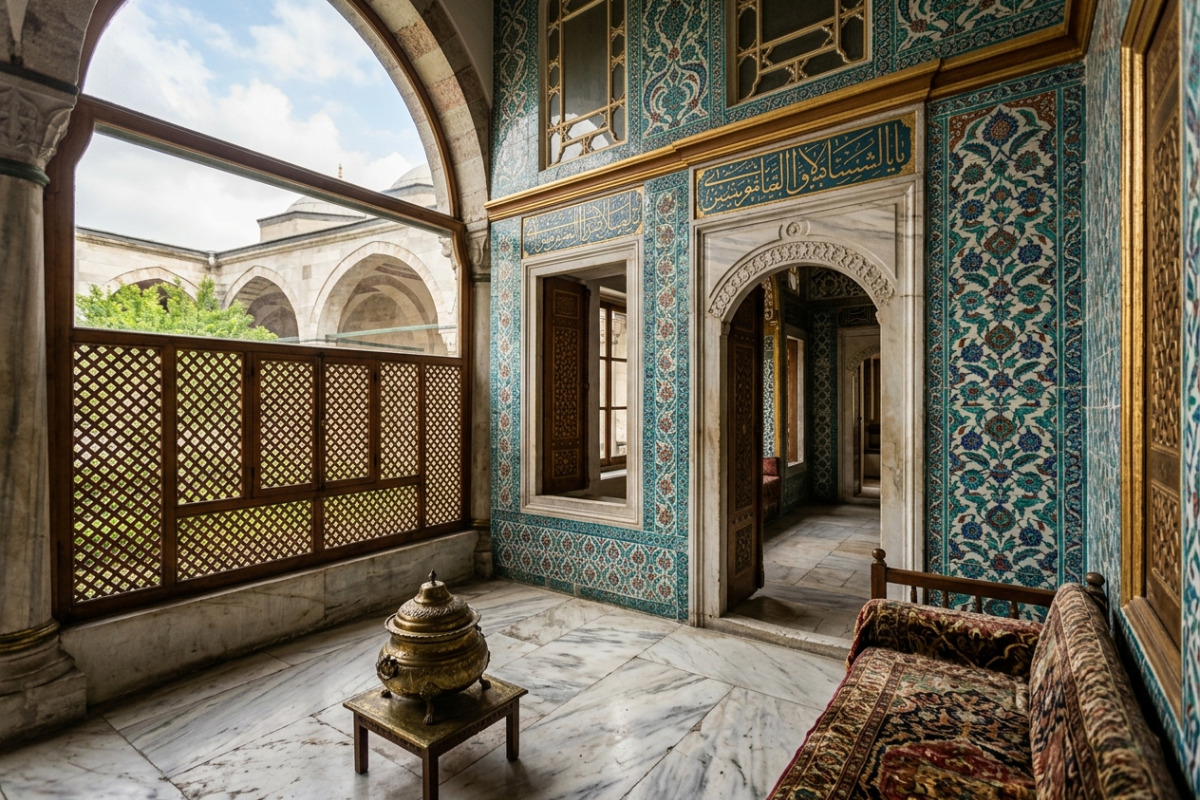
No discussion of Topkapi is complete without mentioning the world-renowned Iznik tiles and ceramics. These pieces represent the zenith of Islamic ceramic art. The influence here is a blend of Chinese porcelain techniques (highly prized by the Sultans) and Islamic design principles. The palace kitchens house an immense collection of Chinese celadon and blue-and-white porcelain, which inspired local artisans. However, the Ottoman potters adapted these influences to create something entirely new: the underglaze technique featuring the famous tomato red, cobalt blue, and emerald green.
The motifs on these ceramics are deeply symbolic. The tulip, which appears frequently on plates, vases, and wall tiles, is an anagram for "Allah" in Ottoman script and symbolizes the oneness of God. The rose represents the Prophet Muhammad. Thus, a simple dish or a wall panel becomes a garden of spiritual contemplation. The layout of the tiles often utilizes geometric grids to create infinite repeating patterns, turning the walls of the Harem and the Privy Chamber into shimmering reflections of paradise.
| Artistic Medium | Key Islamic Influence | Symbolic Representation |
| Jewelry & Metalwork | Symmetry & Arabesque | Order of the universe; gemstones represent divine light. |
| Textiles (Kaftans) | Chintamani & Floral | Power (leopard spots/tiger stripes) and the garden of Paradise. |
| Miniature Painting | Two-dimensional perspective | Depicting the essence of an event rather than a realistic snapshot; avoiding idolatry. |
| Woodworking (Kundekari) | Interlocking Geometry | Unity in multiplicity; stars representing the heavens. |
Miniatures and Manuscripts: Storytelling in Gold and Ink
The collection of miniatures at Topkapi offers a fascinating insight into the Ottoman worldview. Unlike Western Renaissance art that played with shadow and perspective to create realism, Islamic miniature painting flattens the image. This was a conscious stylistic choice rooted in the philosophy that mimicking God's creation perfectly is impossible and presumptuous. Instead, the artist captures the essence of the scene. The Sultan is often depicted larger than others to denote hierarchy, and the colors are vivid and jewel-like, unaffected by shadow.
These manuscripts cover history, science, and literature. The Surname (Book of Festivals) manuscripts are particularly notable. They document the public life of the empire—parades, guild processions, and circumcisions—blending documentary precision with the stylized beauty of Islamic art. The margins of these pages are often as precious as the illustrations themselves, dusted with gold flecks or painted with intricate floral borders that require a magnifying glass to fully appreciate.
The Treasury: The Art of Adornment
The Imperial Treasury is often the highlight for many visitors, dazzling the eyes with the Spoonmaker's Diamond and the Topkapi Dagger. However, look closer at the setting of these stones. The influence of Islamic art is evident in the technique. The Ottomans preferred the murassa technique, where stones are set into the metal to create a smooth, encrusted surface, rather than the Western claw setting. The arrangement of gems often follows geometric patterns—circles, rosettes, and stars—mirroring the designs found in tile work and carpets.
Even weapons were treated as canvases for art. Daggers, swords, and shields are inlaid with ivory, mother-of-pearl, and precious stones forming verses from the Quran or protective prayers. This transforms a weapon of war into a talisman, protecting the warrior not just physically but spiritually. The artistry involved in the ceremonial armor shows that in the Ottoman mind, beauty and strength were inseparable, both flowing from the same divine source.
A Legacy Carved in History
Leaving the Topkapi Palace, one carries away more than just memories of gold and marble. The collections here are a vivid narrative of how a civilization interpreted the world through the lens of faith. The influence of Islamic art on these pieces is not merely a matter of style; it is the very breath that gives them life. From the geometric precision that speaks of cosmic order to the flowing calligraphy that sings the praises of the Creator, the Topkapi collections stand as a monumental bridge between the earthly and the divine. They remind us that for the Ottomans, art was a form of prayer, and beauty was the ultimate truth.