Stepping through the Gate of Carriages into the Harem of Topkapi Palace feels less like entering a room and more like crossing a threshold into a completely different dimension of history. While the outer courtyards of the palace speak of administrative power and military might, the Harem whispers of intimacy, secrecy, and profound artistic expression. For many travelers visiting Istanbul in 2026, this section remains the most enigmatic part of the complex. It is not merely a residence; it is a sprawling, organic architectural organism that evolved over four centuries, reflecting the changing tastes, needs, and hierarchies of the Ottoman dynasty. The silence here is heavy with stories, but it is the walls, the domes, and the corridors that tell them best.
The Spatial Layout: A Labyrinth of Secrets
Unlike the symmetrical and planned layout of European palaces like Versailles, the architecture of the Harem is defined by its additive nature. It grew organically, expanding wing by wing as new Sultans ascended the throne and the population of the Harem increased. This resulted in a mesmerizing labyrinth of over 300 rooms, nine hammams, two mosques, and a hospital, all connected by narrow corridors and hidden courtyards. The layout was designed with a strict hierarchy in mind, separating the service areas of the Black Eunuchs from the concubines, and the concubines from the sacred privacy of the Sultan and the Queen Mother.
The genius of this design lies in its ability to create distinct worlds within a confined space. The corridors, such as the famous Golden Road (Altınyol), served as the arteries of this hidden city. While narrow and seemingly utilitarian, these passages were the stage for significant ceremonial processions. The architecture here forces a sense of disorientation upon the intruder while offering security and seclusion to the resident, perfectly embodying the word 'Harem,' which literally translates to 'forbidden' or 'protected.'
The Courtyard of the Queen Mother
The epicenter of this architectural web is undoubtedly the Courtyard of the Valide Sultan (Queen Mother). As the most powerful woman in the Ottoman Empire, her living quarters were positioned to command authority. The architecture here shifts from the claustrophobic corridors to an open, airy grandeur. The courtyard serves as a central hub, connecting the Sultan’s private apartments with the quarters of the favorites and the service wings. The intricate lattice screens and the positioning of the windows allowed the Valide Sultan to monitor the daily flow of life in the Harem without being seen, a masterful example of architecture serving the purpose of surveillance and control.
Consider, for instance, the strategic placement of the Valide Sultan's divan (a raised platform for seating). It was often positioned near a window overlooking the courtyard, allowing her to observe activities discreetly. This subtle architectural detail underscores her power and influence within the Harem.
Artistic Mastery: The Language of Decoration
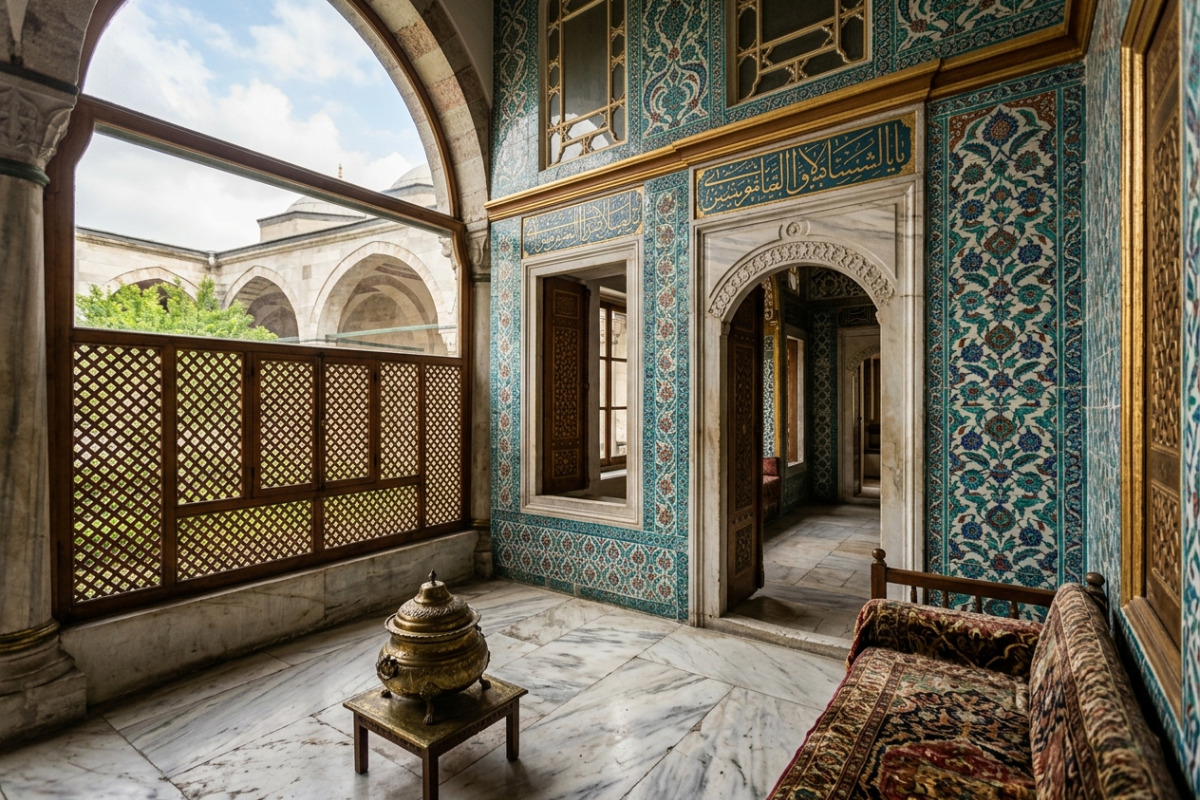
While the stone walls provided structure, it is the decorative arts that breathe life into the Harem. The interiors are a testament to the zenith of Ottoman artistic achievement, particularly during the 16th and 17th centuries. The walls are not simply painted; they are sheathed in a ceramic skin that transforms the cold stone into an eternal garden. The use of light is also manipulated through stained glass windows, creating a kaleidoscope effect that changes with the position of the sun, symbolizing the divine presence within the ruler's home.
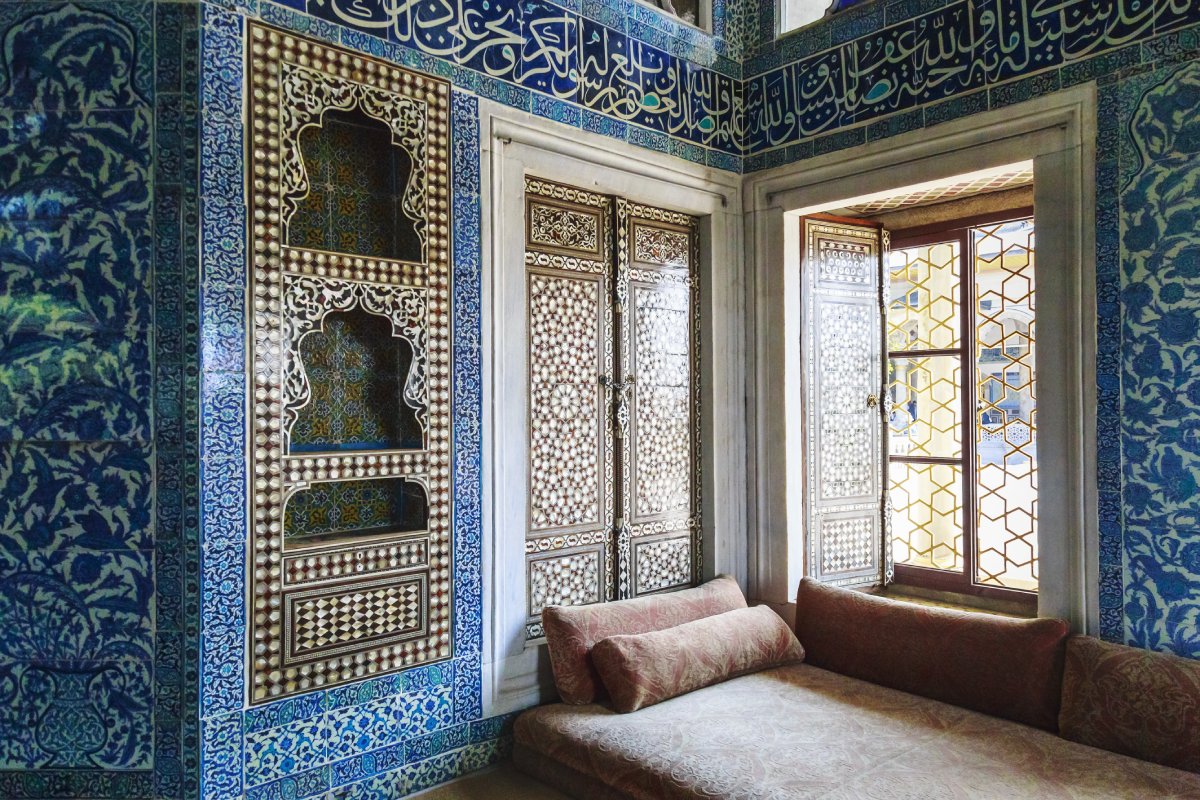
- Iznik Tiles: The Harem contains some of the finest examples of Iznik tiles in existence. Unlike the earlier blue-and-white ceramics, the tiles here feature the famous 'coral red' relief, a color that was technically difficult to achieve and was lost to history for centuries.
- Kundekari Woodwork: Look closely at the cupboard doors and shutters. They utilize an interlocking tongue-and-groove technique that requires no nails or glue, allowing the wood to expand and contract with Istanbul’s humidity without warping.
- Calligraphy as Decor: The walls are adorned with Quranic verses and poetry. These are not random; they serve as spiritual protection and reminders of the Sultan's duty to God and his subjects.
- Malakari Plasterwork: The domes are often decorated with intricate plaster carvings, painted in gold and royal blue, adding depth and texture to the ceilings.
The arabesque patterns found in the Malakari plasterwork, for example, are not merely decorative. They represent the infinite nature of God and the interconnectedness of all things, reflecting the philosophical underpinnings of Ottoman art.
The Privy Chamber of Murad III
Perhaps the most stunning example of interior architecture is the Privy Chamber of Murad III, designed by the legendary architect Mimar Sinan. It is a masterpiece of classical Ottoman architecture. The room features a two-tiered arrangement of windows, with the lower ones equipped with shutters for privacy and the upper ones consisting of colored glass to admit celestial light. The highlight, however, is the marble fountain embedded in the wall. This was not just a luxury; it was an acoustic device. The sound of cascading water was engineered to soothe the Sultan’s mind and, crucially, to prevent eavesdroppers from hearing private conversations held within the chamber.
Another notable feature of this chamber is the use of muqarnas, a type of corbelled vaulting that resembles a honeycomb. These intricate structures not only add visual interest but also help to diffuse sound, further enhancing the room's acoustic properties.
Architectural Functions of Key Chambers
To truly appreciate the Harem, one must understand that every room was purpose-built with specific architectural features to support the complex social structure of the court. The following table breaks down the unique design elements of the most significant spaces:
| Chamber Name | Key Architectural Feature | Cultural Significance |
| The Imperial Hall (Hünkâr Sofası) | Largest dome in the Harem, raised platform for the throne. | The main reception hall where the Sultan met with his family and the Harem residents for entertainment and ceremonies. |
| Apartments of the Crown Prince (Twin Kiosks) | Stained glass windows, high conical ceiling, isolated location. | Designed as a 'Golden Cage' (Kafes) where princes lived in seclusion to prevent succession wars. |
| The Fountain Hall | Monumental entrance with Kutahya tiles (later period). | Served as a transition zone and waiting area, blending 17th-century architecture with 19th-century renovations. |
| Apartments of the Favorites | Overlooking the pool and the Bosphorus. | Provided the best views and airiest spaces, signifying the elevated status of the Sultan's favorite consorts. |
Light, Shadow, and the Architecture of Privacy
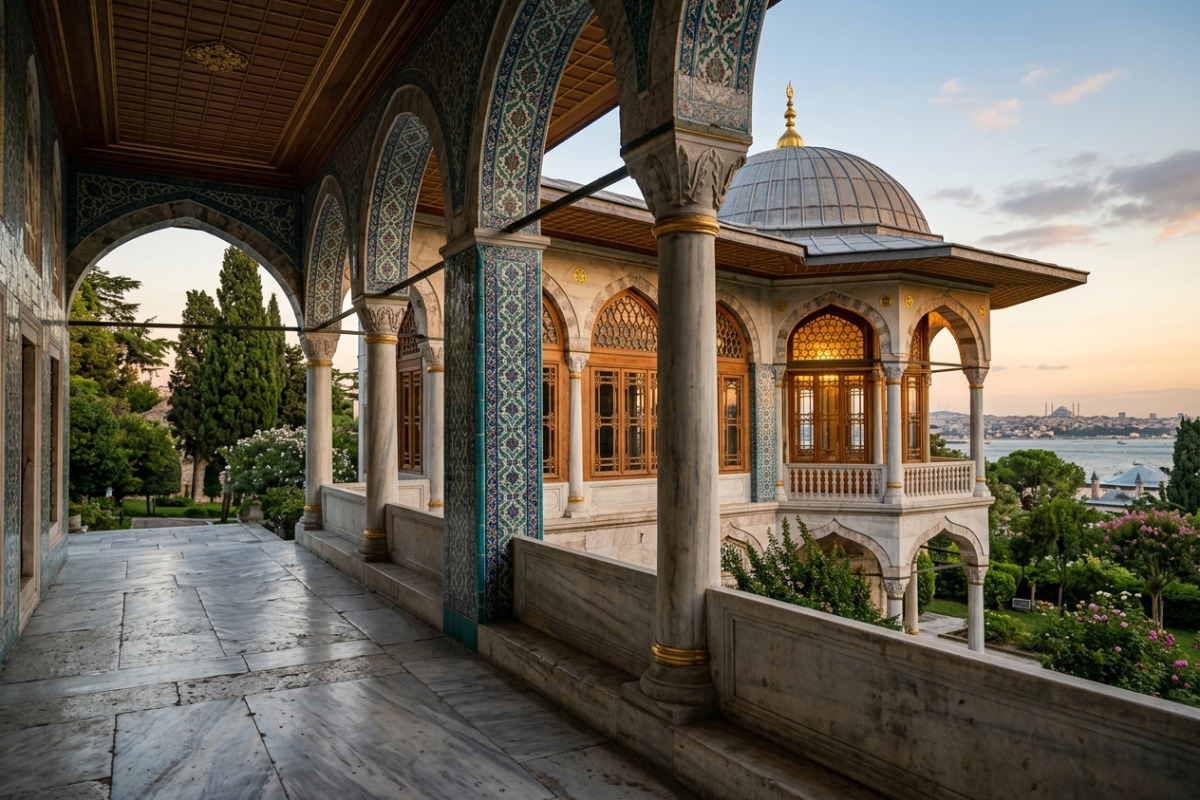
The most pervasive theme in the Harem's architecture is the manipulation of privacy. The design is an exercise in introversion. The buildings turn their backs on the city and the public courtyards, focusing inward toward private gardens and light wells. High walls ensure that no line of sight exists from the outside world. Yet, the architects ensured the space did not feel like a dungeon. They achieved this through the strategic use of domes and skylights (lanterns) that flood the windowless corridors with natural light.
The latticework screens (mashrabiya) are another brilliant architectural solution found throughout the Harem. They allowed the women of the court to look out onto the Golden Horn or the courtyards below to watch ceremonies, enjoying the view and the breeze, while remaining completely invisible to the outside world. This visual permeability was one-way, reinforcing the power dynamic where the Sultan and his household could see all, but could not be seen.
The placement of windows was also carefully considered. Windows were often positioned high up or obscured by latticework, allowing light to enter while maintaining privacy. This created a play of light and shadow that added to the Harem's mystique.
A Cultural Legacy Etched in Stone
Visiting the Harem is a journey through the evolution of Ottoman style. You can see the transition from the classical, restrained elegance of the 16th century to the more ornate, European-influenced Baroque and Rococo styles of the 18th and 19th centuries. The Fruit Room of Ahmed III, for instance, abandons geometric tile patterns for painted panels of flowers and fruit bowls, signaling the Tulip Era's obsession with nature and leisure.
The architecture of the Topkapi Harem is a physical manifestation of Ottoman culture itself: complex, hierarchical, deeply private, and obsessed with beauty. It is a hidden oasis where stone and tile were used to create a paradise on earth, shielded from the harsh realities of empire management. As you walk through these empty halls, try to listen to the acoustics of the fountains and admire the way the light hits the 500-year-old tiles. It is in these details that the true wonder of the Harem resides.